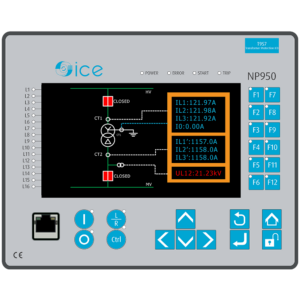
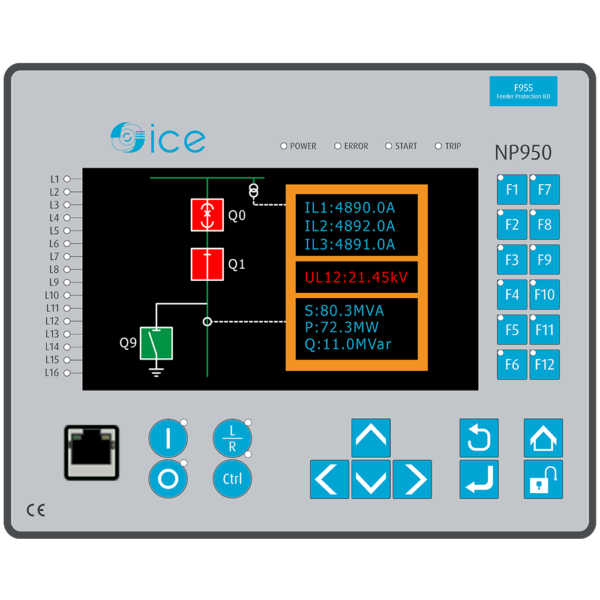

NPF955
indus

NPF955

Feeder and line differential protection IED

The NPF955 feeder and line differential protection device offers a modular solution for feeder and line protection and control for applications that require a large I/O capacity.

It features line differential protection for two line terminal ends, while supporting extensive monitoring and control applications.

You can add up to total 11 optional modules (I/O and other type of modules) into the device to expand its monitoring and control capabilities. The NPF955 feeder and line protection device communicates using various protocols, including the IEC 61850 substation standard.

, , ,
Smart dedicated process bus
Transfers standard data and up to 64 user-defined signals
Automatically synchronizes line differential protection settings from the master to the sub-node device
Compensates for communication delays without external time synchronization
A large I/O capacity
Double busbar control
Optional automatic/manual voltage regulation and/or parallel voltage regulation (AVR)
Optional transformer module protections
5-shot scheme-controlled auto-recloser
Communication interfaces
Communication protocols
Measurements & monitoring
Power supply
Software packages
Type of option cards
Current inputs
  • 3
Sensitive current inputs
  • 2
Voltage outputs
  • 4
Disturbance records
  • 100
Event logs
  • 15000
Digital inputs
  • 3
Digital outputs
  • 5
Watchdog output
  • 1
Indication LEDs
  • 20
Number of optional modules
  • 11
  • 21 — Underimpedance
  • 21FL — Underimpedance fault locator
  • 24 — Overfluxing
  • 25 — Synchro-check
  • 27 — Undervoltage
  • 32 — Directional power
  • 32N — Zero-sequence directional power protection
  • 32O — Directional overpower
  • 32R — Reverse active power
  • 32U — Directional underpower
  • 40 — Loss of field
  • 46 — Reversal, loss of phase or unbalance phase
  • 46L — Maximum ratio of negative and phase current
  • 47 — Negative sequence overvoltage
  • 49F — Cable thermal overload
  • 49T — Transformer thermal overload
  • 50 — Instantaneous overcurrent
  • 50ARC — Arc flash protection
  • 50BF — Breaker failure
  • 50H — Instantaneous harmonic overcurrent
  • 50N — Instantaneous residual overcurrent
  • 51 — Time overcurrent
  • 51H — Time harmonic overcurrent
  • 51N — Time residual overcurrent
  • 51V — Voltage-restrained time overcurrent
  • 52 — Breaker failure position
  • 59 — Overvoltage
  • 59N — Zero sequence overvoltage
  • 60 — Voltage balance
  • 67 — Phase directional overcurrent
  • 67N — Earth directional overcurrent
  • 67NI — Intermittent earth directional overcurrent
  • 68H — Inrush harmonic blocking
  • 78 — Loss of synchronism – vector jump
  • 79 — Autorecloser
  • 79N — Automatic reclosing / synchronism check – neutral
  • 81O — Overfrequency
  • 81R — Rate of change of frequency – ROCOF
  • 81U — Underfrequency
  • 87C — Cable-end differential protection
  • 87L — Line differential
  • 90 — Voltage regulator
  • 99 — Programmable functions and logical editor
  • CBW — Circuit breaker wear monitoring
  • CTS — Current transformer supervision
  • RTD — RTD temperature sensor
  • TST — Transformer status monitoring

Need any advice?

For over 75 years, we have been supporting the energy transition by designing protection and control solutions for electrical networks.
Contact us